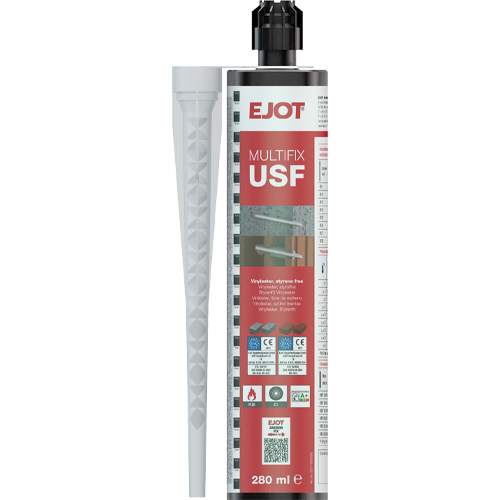

 Anchorfix 1
IN STOCK
Product video
 Sika
AnchorFix 1 Chemical anchor 300ml
Sika AnchorFix-1 Chemical Anchor 300ml – Professional Anchoring Adhesive for Concrete and Masonry
Reliable anchoring is essential when installing threaded rods, reinforcing steel, bolts and other fastening systems into concrete or masonry. A poorly selected or incorrectly installed anchor can compromise the connection, damage the substrate and create unnecessary maintenance or safety risks.
For professional contractors, steel fabricators, engineers and construction teams, Sika AnchorFix-1 provides a fast-curing, two-component polyester anchoring adhesive designed for suitable fastening applications in uncracked concrete and solid or hollow masonry.
Unlike conventional expansion anchors, which rely on mechanical expansion against the sides of a drilled hole, chemical anchoring uses an injection adhesive to bond the embedded fixing to the surrounding substrate. When the correct resin, anchor dimensions, hole preparation and installation procedure are used, this creates a bonded anchoring system suitable for applications specified by the manufacturer.
Sika AnchorFix-1 is a solvent-free and styrene-free polyester anchoring adhesive. It is designed for fixing threaded rods, reinforcing steel, bolts and special fastening systems into approved substrates. It is suitable for dry, damp and water-filled holes within the manufacturer's stated application scope.
The product is supplied in a 300ml cartridge and uses a static mixing nozzle to combine its two components during dispensing. Its thixotropic consistency helps prevent sagging, including in vertical and overhead applications.
Startcore Ventures Limited supplies Sika AnchorFix-1 in Nairobi, Kenya, for contractors, installers, engineers, industrial maintenance teams and construction procurement departments.
Product: Sika AnchorFix-1
Packaging: 300ml cartridge
Product type: Two-component polyester chemical anchoring adhesive
Price: KSh 2,800 inclusive of VAT
Supplier: Startcore Ventures Limited, Nairobi, Kenya
1. What Is Sika AnchorFix-1?
Sika AnchorFix-1 is a two-part polyester-based injection adhesive developed for chemical anchoring applications.
The cartridge contains two separate components that are combined through a static mixing nozzle during application. The mixing process initiates the curing reaction, allowing the injected adhesive to harden around the fixing element and bond it to the surrounding substrate.
The product is designed for anchoring applications involving:
- Threaded rods
- Reinforcing steel bars
- Bolts
- Special fastening systems
The manufacturer identifies the following substrates within the product's application scope:
- Concrete
- Solid masonry
- Hollow masonry
- Hard natural stone
- Solid rock
For concrete applications, the Kenya product data sheet identifies anchoring in uncracked concrete. It also identifies approvals for suitable anchoring applications in solid and hollow masonry.
This distinction matters. Sika AnchorFix-1 should not be marketed as a universal resin for cracked concrete or every structural anchoring requirement. The correct product must be selected according to the substrate, anchor type, loading conditions and relevant technical approval.
2. How Does a Chemical Anchor Work?
A chemical anchor is an adhesive-based fastening system used to secure a metal fixing inside a drilled hole.
The process involves drilling a hole into a suitable substrate, cleaning the hole, injecting the anchoring adhesive and inserting the fixing element before the adhesive cures.
Once cured, the adhesive bonds the fixing to the surrounding substrate.
Unlike a conventional expansion anchor, which applies mechanical expansion pressure against the hole walls, a chemical anchor relies on an adhesive bond between the fixing, resin and substrate.
This makes chemical anchoring useful in applications where a bonded fixing system is specified.
The performance of the finished anchor depends on several factors:
- The strength and condition of the concrete or masonry.
- The diameter and depth of the drilled hole.
- The diameter, type and condition of the threaded rod or reinforcing steel.
- Correct cleaning of the drilled hole.
- Correct resin mixing and injection.
- Correct anchor installation before the resin's working time expires.
- Sufficient curing time before loading.
- The design loads and environmental conditions.
A chemical anchor is not automatically stronger than every mechanical fixing. Its suitability must be established for the specific application.
3. Main Features and Benefits of Sika AnchorFix-1
Fast-curing polyester formulation
Sika AnchorFix-1 is designed to cure relatively quickly, depending on the cartridge and substrate temperature. This helps contractors complete suitable anchoring work without unnecessarily long waiting periods.
The working time and curing time are different. The fixing must be installed within the available working time, but it must not be loaded until the required curing time has elapsed.
Two-component injection system
The two components are mixed through a static mixing nozzle as the adhesive is dispensed.
This provides a controlled mixing process without requiring the installer to manually mix separate resin and hardener containers.
Styrene-free formulation
Sika identifies AnchorFix-1 as styrene-free. It is also described as solvent-free.
This is a relevant product characteristic for professional users who need to select an appropriate anchoring adhesive for their working environment.
Suitable for dry, damp and water-filled holes
The Kenya product data sheet identifies suitability for dry, wet and water-filled holes.
However, this should not be interpreted as permission to ignore hole preparation or the installation procedure. The specified drilling, cleaning, injection and curing instructions must still be followed.
Non-sag consistency
The adhesive is thixotropic and designed not to sag in vertical and overhead applications.
This is useful when installing fixings in walls, ceilings and other orientations where a low-viscosity resin could flow out of the hole.
Suitable for standard sealant dispensers
The product can be applied using standard sealant dispensers compatible with the cartridge. The correct dispensing arrangement and static mixing nozzle must be used.
Low odour and low wastage
Sika identifies low odour and low wastage among the product's characteristics.
Correct dispensing and installation procedures help reduce unnecessary material loss.
Technical approvals
The Kenya product data sheet identifies:
- ETA-13/0720 for bonded fasteners in uncracked concrete.
- ETA 17/0179 for injection anchors in masonry.
The approvals apply within their stated scope. They do not mean that every anchor diameter, embedment depth, substrate or loading arrangement is automatically approved.
4. Where Can Sika AnchorFix-1 Be Used?
Sika AnchorFix-1 is intended for professional chemical anchoring applications where the selected fixing and substrate fall within the manufacturer's technical scope.
A. Threaded rod installation
Threaded rods are widely used in construction and industrial installation work.
Sika AnchorFix-1 can be used for suitable threaded rod anchoring into uncracked concrete and approved masonry applications.
Potential applications include:
- Fixing support brackets
- Installing threaded rod supports
- Securing selected equipment mounting systems
- Fixing suitable steel components
- Installing fastening points for mechanical and electrical services
- Suitable building-services support installations
The rod diameter, embedment depth, spacing and loading must follow the approved design and applicable technical documentation.
B. Reinforcing steel anchoring
Reinforcing steel may need to be bonded into existing concrete or masonry as part of a specified installation.
Sika AnchorFix-1 is identified for anchoring reinforcing steel in the manufacturer's product data.
Possible applications include suitable reinforcement connections, extensions and fixing details where the design specifies an approved bonded anchoring system.
Do not assume that every rebar connection can be completed using this product. Structural reinforcement details must be designed and checked by a qualified professional.
C. Bolt and fastening-system installation
The product is suitable for bolts and special fastening systems within its technical scope.
This can include selected fixing arrangements for construction components, equipment and other installations requiring an adhesive anchor.
The complete fixing arrangement must be assessed, including the base material, anchor dimensions and applied load.
D. Concrete anchoring
Sika AnchorFix-1 is specified for anchoring in uncracked concrete.
It can be considered for suitable applications involving:
- Threaded rods
- Reinforcing bars
- Bolts
- Special fastening systems
The concrete must be suitable for the intended application. Sika's instructions require mortar and concrete to be older than 28 days and the substrate strength to be verified.
Where the concrete strength is unknown, pull-out testing may be required.
E. Solid masonry
The product is also identified for suitable solid masonry anchoring applications.
The masonry type, condition, strength and geometry must be assessed before installation.
Do not assume that every brick, block or stone substrate will provide the same anchoring performance.
F. Hollow masonry
Sika AnchorFix-1 can be used in suitable hollow masonry applications.
A perforated sleeve is required for the installation procedure described by Sika. The sleeve helps contain the resin and allows the adhesive to form the intended bond around the fixing.
For hollow block applications, Sika instructs installers not to use rotary hammer drilling. Follow the specified drilling and hole-cleaning procedure for the selected sleeve and anchor size.
G. Natural stone and solid rock
The manufacturer lists hard natural stone and solid rock as possible substrates.
However, these materials can vary significantly in strength, composition and porosity.
Sika specifically recommends testing suitability on a sample area, including checking bond strength and possible surface staining or discolouration.
5. Technical Specifications of Sika AnchorFix-1
The following information is based on the Sika Kenya Product Data Sheet, April 2025, Version 05.02.
Technical characteristic Specification
Product name | Sika AnchorFix-1
Product type | Fast-curing polyester anchoring adhesive
Chemical base | Two-component polyester
Styrene | Styrene-free
Solvent | Solvent-free
Packaging | 300ml standard cartridge
Mixing ratio | Part A : Part B = 10:1 by volume
Mixed density | Approximately 1.63kg/L
Cured colour | Light grey for concrete applications
Application | Threaded rods, reinforcing steel, bolts and special fastening systems
Substrates | Concrete, solid and hollow masonry, hard natural stone and solid rock
Sag flow | Non-sag, including overhead applications
Product temperature | +5°C to +40°C
Ambient temperature | -10°C to +40°C
Substrate temperature | -10°C to +40°C
Compressive strength | 60 N/mm² after 7 days at +20°C
Tensile strength | 12 N/mm² after 7 days at +20°C
Tensile strength in flexure | 28 N/mm² after 7 days at +20°C
Long-term service temperature | -40°C to +50°C
Short-term service temperature | Up to +80°C for up to 2 hours
Shelf life | 12 months from production date
Storage | Original sealed packaging, dry conditions, +5°C to +25°C
Price | KSh 2,800 inclusive of VAT
These are manufacturer-published product values. They are not a substitute for anchor-design calculations or project-specific load specifications.
6. Sika AnchorFix-1 Working Time and Curing Time
One of the most important considerations when using a chemical anchor is understanding the difference between working time and curing time.
Working time is the period during which the resin remains suitable for inserting and positioning the anchor.
Curing time is the time required before the anchor can be loaded in accordance with the product instructions.
The Sika Kenya data sheet gives the following typical values:
Temperature Working time (gel time)Curing time
+30°C | 4 minutes | 35 minutes
+25°C to +30°C | 4 minutes | 40 minutes
+20°C to +25°C | 5 minutes | 50 minutes
+10°C to +20°C | 6 minutes | 85 minutes
+5°C to +10°C | 10 minutes | 145 minutes
+5°C | 18 minutes | 145 minutes
-10°C | 30 minutes | 24 hours
The -10°C application row is specifically noted by Sika as outside the scope of the product ETA or other approval.
These figures are temperature-dependent and must be interpreted using the actual cartridge and substrate conditions.
Do not load or move an anchor during the hardening period. Where the application is structural or safety-critical, follow the project design and current manufacturer instructions.
7. How to Apply Sika AnchorFix-1 Correctly
Correct installation is essential. A good chemical anchor depends on proper drilling, cleaning, resin mixing, injection and curing.
The following procedure summarises Sika's installation instructions. It is intended for experienced professional installers.
Step 1: Inspect and prepare the substrate
Confirm that the substrate is suitable for the intended anchoring application.
Sika specifies that mortar and concrete should be older than 28 days.
Verify the substrate strength. If the strength is unknown, carry out pull-out testing as required.
Check for loose material, oil, grease, dirt and other contaminants.
Step 2: Drill the hole
Use an appropriate electric drill and the correct drill bit.
The diameter and depth must correspond to the anchor size and the applicable technical documentation.
Do not select the hole diameter or embedment depth by guesswork.
For hollow block applications, Sika instructs installers not to use rotary hammer drills. Use the appropriate drilling method and perforated sleeve.
Step 3: Clean the drilled hole
Hole cleaning is one of the most critical stages of chemical anchoring.
Drilling dust can prevent the resin from bonding properly to the substrate.
For solid masonry and concrete, Sika specifies a cleaning procedure using:
- An oil-free blow pump or compressed air, starting from the bottom of the hole.
- A suitable hybrid brush with a diameter larger than the drilled hole.
- Repeated blowing and brushing according to the manufacturer's instructions.
The Sika data sheet specifies a minimum of two cleaning cycles for the relevant blowing and brushing steps.
Do not replace this process with a quick surface wipe.
Step 4: Prepare the cartridge
Unscrew the cartridge cap.
Cut the film if required and attach the correct static mixing nozzle.
Place the cartridge into a compatible dispenser.
When work is interrupted, the static mixer can remain attached after the gun pressure has been relieved. If resin has hardened inside the nozzle, fit a new nozzle before resuming.
Step 5: Dispense until the components are mixed uniformly
Before injecting the resin into the hole, dispense material until both components emerge uniformly mixed.
Discard this initial material as instructed by Sika.
This step is important because the first material coming through the nozzle may not yet have the correct mixture.
Step 6: Inject the resin from the bottom of the hole
Insert the static mixer towards the bottom of the drilled hole.
Inject the resin while slowly withdrawing the mixer.
Work from the bottom towards the opening to avoid trapping air inside the hole.
For deeper holes, extension tubing can be used as described in the manufacturer's instructions.
Step 7: Insert the threaded rod or reinforcing steel
Insert the anchor while the resin is still within its available working time.
Use a rotary motion when inserting the rod or reinforcement into the filled hole.
Some adhesive should come out of the hole, indicating that the available space has been filled.
Step 8: Allow the adhesive to cure
Do not move or load the anchor during the curing period.
Allow the resin to reach the required cure according to the actual temperature and the manufacturer's data.
Step 9: Inspect the completed installation
Check that the anchor has been installed according to the specified dimensions and procedure.
For critical installations, verification and testing should be carried out in accordance with the project requirements.
8. Using Sika AnchorFix-1 in Hollow Blocks
Hollow masonry requires a different installation approach from solid concrete.
The internal cavities of hollow blocks make it difficult to retain injected adhesive without the appropriate installation accessory.
Sika's procedure for hollow blocks includes the use of a perforated sleeve.
The general process is:
- Drill the hole using an electric drill, not a rotary hammer drill.
- Clean the hole with the specified brush.
- Use an oil-free blow pump to remove remaining dust.
- Insert the correct perforated sleeve fully into the drilled hole.
- Dispense the adhesive until both components are uniformly mixed and discard the initial material.
- Inject the resin from the bottom of the sleeve while withdrawing the mixer.
- Close the sleeve cap to prevent adhesive escaping during rod insertion.
- Insert the appropriate steel rod using a rotary motion.
- Do not move or load the anchor before the required curing time has elapsed.
The perforated sleeve size and anchor dimensions must be selected according to the manufacturer's technical documentation.
9. Common Chemical Anchor Installation Mistakes
Even a professional-grade anchoring adhesive can deliver poor results when installation procedures are ignored.
Failure to clean the hole
This is one of the most important mistakes to avoid.
Drilling dust creates a barrier between the adhesive and the substrate. A hole that looks clean from the surface may still contain dust deeper inside.
Follow the complete blowing and brushing procedure.
Using the wrong drill diameter
A hole that is too large or too small can compromise the intended anchoring arrangement.
Use the specified drill diameter and embedment depth.
Incorrect resin mixing
The two components must be properly mixed through the static mixer.
Do not use adhesive that has not emerged uniformly mixed.
Injecting from the wrong direction
Injecting from the opening towards the bottom can trap air inside the hole.
Sika specifies bottom-up injection while slowly withdrawing the mixer.
Inserting the anchor too late
The rod must be inserted within the available working time.
Once the resin starts to gel, the anchor may not be installed correctly.
Loading before curing is complete
An anchor that is disturbed or loaded before curing can lose performance.
Always observe the applicable curing time.
Using the product outside its approved scope
Sika AnchorFix-1 should not be assumed suitable for cracked concrete or every structural fixing requirement.
Where the project requires a different approval, a different resin or a different anchoring system may be necessary.
10. Sika AnchorFix-1 Storage and Handling
Correct storage helps preserve product quality before use.
Sika specifies the following storage requirements:
- Keep the cartridge in its original packaging.
- Store unopened and undamaged cartridges in dry conditions.
- Maintain storage temperatures between +5°C and +25°C.
- Protect the product from direct sunlight.
- Observe the expiry date printed on the cartridge.
- Use the product within its stated shelf life of 12 months from the production date.
Do not use cartridges that are damaged, expired or stored outside the recommended conditions without confirming suitability with the manufacturer.
For safe handling, refer to the latest Safety Data Sheet. Wear suitable protective gloves and eye protection and follow the workplace chemical-handling requirements.
Clean application equipment immediately after use with the cleaning product specified by Sika. Hardened material can only be removed mechanically.
11. Sika AnchorFix-1 Compared with Other Chemical Anchors
Not every chemical anchor is designed for the same application.
The correct product should be selected based on the substrate, anchor type, loading requirements, approvals and installation conditions.
Sika AnchorFix-1
A fast-curing, two-component polyester anchoring adhesive for suitable applications in uncracked concrete and solid or hollow masonry.
It is intended for threaded rods, reinforcing steel, bolts and special fastening systems.
Akfix C900 Chemical Anchor
Akfix C900 is a polyester chemical anchor available in a 310ml cartridge.
It is an alternative to consider for suitable general chemical anchoring work. Compare the relevant technical documentation, substrate approvals and load requirements before selecting it as a substitute.
View Akfix C900 Chemical Anchor
Akfix C920 Chemical Anchor
Akfix C920 is a two-component injection mortar intended for suitable chemical anchoring applications.
It may be considered for projects where its particular resin formulation and technical approvals match the application requirements.
View Akfix C920 Chemical Anchor
Important: Do not choose between these products based on price alone. The manufacturer's approved substrate, anchor dimensions, installation conditions and design loads should determine the selection.
12. Related Products from Startcore Ventures Limited
Chemical anchoring is a complete installation process. The adhesive is only one part of the work. Drilling accuracy, hole cleaning, surface preparation and safe installation are equally important.
Startcore supplies professional construction tools and chemicals that can support related site activities.
1. Akfix C900 Chemical Anchor – 310ml
A polyester chemical anchoring alternative for suitable threaded rod and fixing applications.
Useful for contractors comparing chemical anchor options for concrete and masonry projects.
2. Akfix C920 Two-Component Chemical Anchor
A two-component injection mortar for suitable chemical anchoring applications.
Compare its technical documentation with Sika AnchorFix-1 before choosing a product for a particular project.
3. Bosch GBH 2-24 DRE Rotary Hammer
A professional rotary hammer for drilling suitable holes in concrete and masonry.
The correct drilling equipment and bit are essential for producing the specified hole diameter and depth. For hollow blocks, follow Sika's instruction not to use rotary hammer drilling.
4. Bosch GWS 700 Angle Grinder
A compact angle grinder for suitable metal cutting and surface preparation work.
It can support fabrication and installation activities involving metal components, although it is not a substitute for the specified hole-cleaning equipment.
5. Mapei Eporip 2kg Epoxy Adhesive
A two-component epoxy adhesive for specified concrete bonding and repair applications.
Eporip serves a different purpose from Sika AnchorFix-1. Consider it where the requirement is concrete bonding or a compatible repair application rather than anchoring a threaded rod into a drilled hole.
13. Further Reading – Startcore Resource Centre
For more information about chemical anchoring, product selection and installation considerations, explore these resources:
Chemical Anchors Kenya – Complete Guide to Anchor Resin, Injection Mortar and Concrete Fixings
Understand how chemical anchors work, the differences between resin types, why hole cleaning matters and how to select suitable anchoring products for construction and industrial applications.
Complete Construction Site Setup Checklist for Kenyan Contractors
Explore practical construction-site planning considerations, including materials, tools, equipment and procurement requirements for contractors working in Kenya.
14. Frequently Asked Questions About Sika AnchorFix-1
What is Sika AnchorFix-1 used for?
Sika AnchorFix-1 is a fast-curing, two-component polyester anchoring adhesive used for fixing threaded rods, reinforcing steel, bolts and special fastening systems into suitable concrete and masonry substrates.
What is the size of Sika AnchorFix-1?
The product listed by Startcore is supplied in a 300ml standard cartridge.
What is the price of Sika AnchorFix-1 in Kenya?
The current price displayed on Startcore's product page is KSh 3,000 per 300ml cartridge, inclusive of VAT. Confirm availability and the latest price with the sales team before ordering.
Can Sika AnchorFix-1 be used in concrete?
Yes. The Kenya product data sheet identifies its use for anchoring in uncracked concrete.
Can Sika AnchorFix-1 be used in cracked concrete?
The Kenya product data sheet identifies the concrete anchoring approval for uncracked concrete. Do not specify this product for cracked concrete unless the current applicable technical approval and project design expressly permit that application.
Can Sika AnchorFix-1 be used in hollow blocks?
Yes, for suitable hollow masonry applications. Sika's installation procedure requires the appropriate perforated sleeve and specifies the correct drilling and cleaning method.
Can it be used in damp or water-filled holes?
The Kenya product data sheet identifies suitability for dry, wet and water-filled holes. Correct hole preparation and installation are still required.
Is Sika AnchorFix-1 a two-component adhesive?
Yes. It consists of two components mixed through a static mixing nozzle during dispensing.
Does Sika AnchorFix-1 contain styrene?
No. Sika identifies it as a styrene-free polyester anchoring adhesive.
How long does Sika AnchorFix-1 take to cure?
Curing time depends on temperature. The Kenya data sheet gives typical curing times ranging from 35 minutes at +30°C to 145 minutes at +5°C. At -10°C, the stated curing time is 24 hours, but this application is outside the scope of the product ETA or other approval.
Can Sika AnchorFix-1 be used overhead?
Yes. Sika describes the product as thixotropic and non-sag, including in vertical and overhead applications. The installation must still follow the manufacturer's instructions.
Does it require a special chemical anchor gun?
Sika states that standard sealant dispensers can be used. The dispenser must be compatible with the cartridge and must be fitted with the correct static mixing nozzle.
Why must the drilled hole be cleaned?
Drilling dust and loose particles can interfere with the adhesive bond. Sika specifies repeated blowing and brushing for solid concrete and masonry holes.
Can the anchor be loaded immediately after installation?
No. The anchor must not be moved or loaded during the hardening period. Wait for the curing time applicable to the actual temperature and installation conditions.
What is the shelf life of Sika AnchorFix-1?
Sika specifies 12 months from the production date when the product is stored correctly in its original sealed packaging.
Where can I buy Sika AnchorFix-1 in Nairobi?
You can purchase Sika AnchorFix-1 300ml from Startcore Ventures Limited, Bhavesh Centre, Mezzanine Floor, Office M1C, Ngara Road, Nairobi.
Does Startcore supply chemical anchors to contractors outside Nairobi?
Startcore serves construction and industrial customers across Kenya. Contact the sales team to confirm stock, quantities, delivery arrangements and applicable charges for your location.
15. Buy Sika AnchorFix-1 Chemical Anchor 300ml from Startcore Ventures Limited
When your project requires a professional chemical anchoring adhesive for threaded rods, reinforcing steel, bolts or suitable fastening systems, Sika AnchorFix-1 offers a fast-curing polyester solution for applications within its technical scope.
Its two-component formulation, styrene-free chemistry, non-sag consistency and approvals for specified concrete and masonry applications make it a useful product for professional installation work.
Startcore Ventures Limited supplies construction chemicals, industrial adhesives, waterproofing products, professional power tools and related construction materials to contractors, fabricators, engineers and procurement teams in Kenya.
Product: Sika AnchorFix-1 Chemical Anchor
Packaging: 300ml cartridge
Price: KSh 2,800 inclusive of VAT
Contact Startcore Ventures Limited:
- Sales / WhatsApp: +254 705 544 817
- Office: +254 737 636 611
- Email: [email protected]
- Location: Bhavesh Centre, Mezzanine Floor, Office M1C, Ngara Road, Nairobi
- Website: www.startcore.co.ke
For technical enquiries, share the substrate type, anchor or threaded rod size, intended embedment depth and application. This helps establish whether Sika AnchorFix-1 is suitable or whether another anchoring system should be considered.
Startcore Ventures Limited – Construction Products, Technical Expertise and Professional Procurement Solutions Across Kenya.