 IN STOCK
Product video
 Akfix
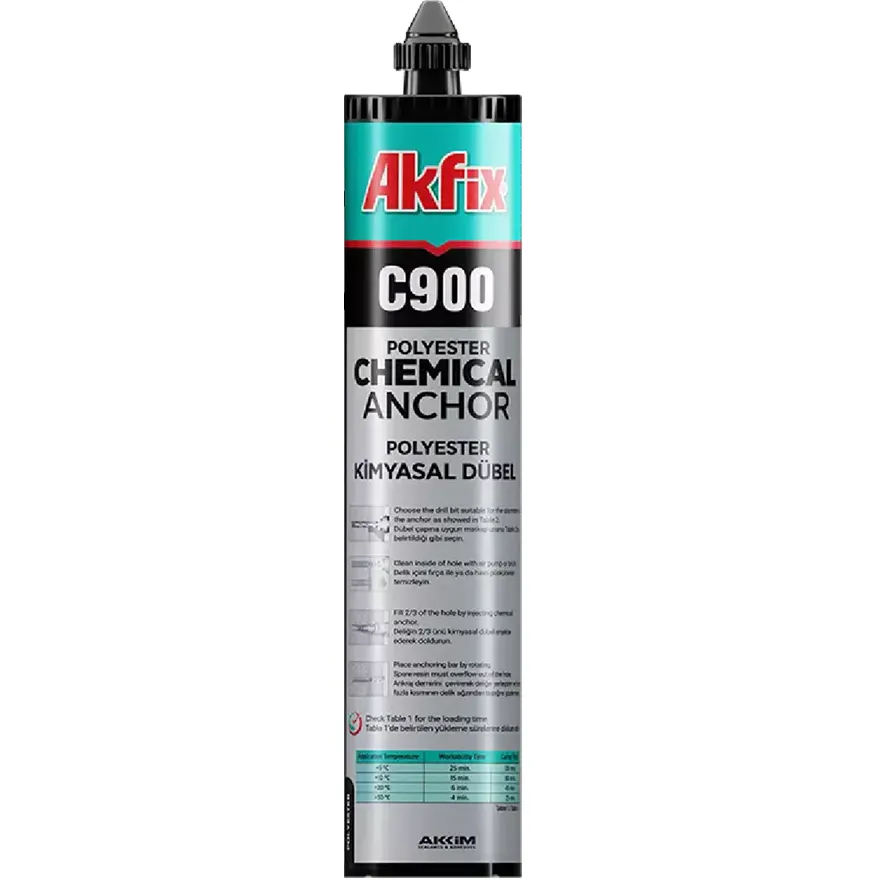
C900 Chemical Anchor Polyester 310ml
Akfix C900 Chemical Anchor Polyester 310ml – Genuine Polyester Injection Mortar | Nairobi, Kenya
Price: KES 2,600 per tube (Inclusive of VAT) Brand: Akfix (Turkey) | Authorized Startcore Ventures Distribution Category: Construction Chemicals / Chemical Anchors & Fixings Type: Two-component polyester injection mortar | Availability: In Stock
Product Overview
If you're looking for a genuine chemical anchor in Nairobi that sets fast, injects cleanly, and holds threaded rod and rebar securely in concrete, brick, and block, Akfix C900 is the practical, cost-effective choice for the great majority of everyday fixing jobs. It is a two-component polyester injection mortar: resin and hardener sit in separate chambers of a single cartridge and only meet inside the mixing nozzle as you dispense. What comes out is a thixotropic paste, meaning it stays where you inject it and doesn't run out of horizontal or overhead holes, that fills the drilled hole completely and bonds to both the rod and the surrounding material.
That full-hole bond is what separates a chemical anchor from a mechanical expansion bolt. An expansion bolt works by wedging itself outward against the walls of the hole, which concentrates stress at a few contact points. In older masonry, hollow block, or close to an edge, that stress can crack or spall the base material. A chemical anchor spreads the load along the entire embedded length of the rod, which is why it is the standard answer when fixings go near edges, into weaker substrates, or into perforated and hollow materials where an expansion bolt has nothing solid to grip.
At KES 2,600 per tube, inclusive of VAT, Startcore Ventures Limited supplies genuine Akfix C900 as an authorized dealer, with M-Pesa checkout so you can secure stock from the site or the office and have it delivered or collected from our Ngara Road branch.
Why Genuine Matters More for Chemical Anchors Than Almost Anything Else on Site
The Kenyan market has no shortage of unbranded, repackaged, or diluted resin cartridges, and a failed chemical anchor is rarely visible at the time it is installed. The fixing looks identical on day one. The problem appears weeks later, when a railing is leaned on, a bracket takes load, or a cable tray fills with cable. By then the anchor has either never fully cured or never fully bonded, and the only way to fix it is to cut it out and start again.
Here is what authenticity actually gets you:
- The correct resin-to-hardener chemistry. The cartridge is built so that the two components dispense in the intended proportion through the nozzle. Diluted or decanted product breaks that proportion, and the usual result is resin that stays soft, tacky, or brittle.
- A predictable working and cure window. Genuine product behaves the way the Akfix data sheet says it will, so you can plan the rod insertion time and the point at which the fixing can be loaded.
- Traceable, sealed packaging. Original cartridges arrive with intact Akfix branding and batch markings rather than refilled or re-labelled tubes.
- Documentation you can rely on. When a site engineer or client asks what was used, you can point to a named, documented product rather than an unknown cartridge.
Every tube of C900 we sell is sourced through authorized channels, not the grey market.
What Akfix C900 Is Designed For (And How to Choose Honestly)
Akfix positions C900 as a general-purpose polyester injection mortar for solid and hollow supports with a short cure time, rated by the manufacturer for low to medium load applications. That is a useful, honest description, and it is worth building your purchasing decision around it.
C900 is an excellent fit for:
- Fixing gates, balustrades, and handrails
- Securing safety barriers and balcony fences
- Mounting canopies, signs, and satellite dishes
- Fixing cable trays, brackets, consoles, and conduit supports
- Installing racking and light-to-medium machinery supports
- Fixing roller blind and shutter frames into masonry
- Anchoring in concrete, solid masonry, hard natural stone, perforated brick, and hollow block
C900 is not the product to default to when a fixing is structurally critical, when it will carry heavy sustained or vibrating loads, or when the design calls for an engineered, approved anchor system. Heavy industrial machinery with continuous vibration, primary structural steel connections, and any fixing where a failure could injure someone should be specified by a structural engineer against a documented load value, and in many of those cases an epoxy-based or approved-system anchor is the right class of product. We would rather tell you that now than have you find out after installation, and our team will gladly help you choose between options when you describe the load, the base material, and the environment.
Key Features
- Suitable for solid and hollow structures, including concrete, perforated brick, and cavity block
- High solid content polyester formulation
- Easy to extrude and inject, with consistent flow through the mixing nozzle
- Thixotropic, so it can be applied in both vertical and horizontal directions without slumping
- Fast curing, letting you move from anchoring to installation much sooner than with slower-curing epoxies
- Standard cartridge format that works with a standard chemical anchor gun
Technical Summary
Property Detail
| Product Type | Two-component polyester injection mortar
| Application Class (per Akfix) | Low to medium load applications in solid and hollow supports
| Suitable Base Materials | Concrete, solid masonry, perforated brick, cavity block, hard natural stone
| Consistency | Thixotropic paste, applicable vertically and horizontally
| Cure Behaviour | Fast curing; time to load depends on ambient and base temperature
| Format | Standard cartridge, used with a chemical anchor gun and static mixing nozzle
| Pack Size (this listing) | 310ml tube
Cure time and working time vary with temperature, so always refer to the current Akfix technical data sheet for the figures that apply to your site conditions before loading a fixing. We can supply the data sheet on request.
Chemical Anchor or Expansion Bolt? Why Resin Wins in Kenyan Conditions
Plenty of fixings in Nairobi buildings are still done with plug-and-screw or expansion bolts, so it is worth being clear about when switching to resin pays off.
Near edges and corners. An expansion bolt pushes outward, and close to an edge the concrete simply splits. Resin transfers load along the rod instead of pushing sideways, so edge distances can be handled far more safely.
Hollow and perforated materials. Many walls on Kenyan sites are hollow block or perforated brick, where an expansion bolt has little or nothing to bite into. Resin fills the cavity, and with a mesh sleeve it bonds through the web of the block. Ask our team for sleeves compatible with your block type.
Older or weaker concrete. Mechanical anchors rely on the base material resisting expansion. In older or lower-grade concrete that resistance is unreliable. Resin spreads the load and is much more forgiving.
Vibration and movement. A mechanical bolt can work loose over time. A bonded rod is locked along its whole length.
Large or awkward spacing. Because resin doesn't expand against the base material, fixings can be closer together without stressing the substrate.
The trade-off is that resin demands better installation discipline: a clean hole, correct injection, and a proper cure time. That is exactly what the installation guide below covers.
Polyester or Epoxy? Choosing Between C900 and Its Siblings
Polyester and epoxy resins are both chemical anchors, but they behave differently, and picking the right one saves money without compromising the job.
Polyester (such as C900) cures quickly, costs less, and is the sensible default for general fixings in solid and hollow masonry at low to medium loads. Speed matters on a busy Nairobi site: you can drill, inject, set, and move on.
Epoxy-based anchors generally cure more slowly but are typically selected for more demanding conditions, such as higher loads, tougher substrates, or longer-term performance requirements. If your job sits at the heavier end, look at the Akfix C920 chemical anchor injection mortar, which sits above C900 in the Akfix range and is available from us in stock. Compare the data sheets for load classes and base materials before choosing.
A simple rule of thumb: if you are fixing a handrail, gate, bracket, tray, or sign, C900 is usually the efficient choice. If you are fixing something heavy, vibrating, or safety-critical, step up the range and involve an engineer.
Professional Installation Guide: Getting a Reliable Bond
A chemical anchor is only as good as the hole it goes into and the care taken during injection. Follow these steps every time.
1. Plan the fixing. Confirm the rod diameter, the hole diameter recommended for that rod, and the embedment depth. Check the Akfix data sheet and, for anything load-bearing, the engineer's specification. Mark edge and spacing distances before you drill.
2. Drill a clean, straight hole. A rotary hammer drill gives you a straight, correctly sized hole in concrete and masonry. We stock the Bosch GBH 2-24 DRE rotary hammer, a trusted choice for exactly this task. Use the right bit for the base material, and hold the drill square to the surface.
3. Clean the hole thoroughly. This is the single most important step and the one most often skipped. Concrete dust coats the walls of the hole and acts as a barrier that stops the resin from bonding. Brush the hole with a stiff brush of the correct diameter, then blow it out, and repeat the brush-and-blow cycle until the hole is free of dust. Wear eye protection while blowing out.
4. Load the cartridge. Fit the cartridge into a chemical anchor gun and screw on a new static mixing nozzle. The Akfix AKT 351 chemical anchor gun gives you the controlled, even dispensing that chemical anchors need. Never use a nozzle that has already been used and left to harden.
5. Discard the first dispense. Squeeze out the first several centimetres of resin onto a scrap surface until the mixed material is a uniform colour. The first output is unmixed or poorly mixed and must not go into the hole.
6. Inject from the bottom up. Push the nozzle to the very bottom of the hole and begin injecting, drawing the nozzle back slowly as the hole fills. This pushes air out ahead of the resin and avoids voids. Fill the hole to roughly the proportion recommended on the data sheet; overfilling is wasteful, and underfilling leaves the top of the rod unbonded.
7. Insert the rod with a twisting motion. Push the clean, grease-free threaded rod or rebar to full depth while turning it slowly. The twist works resin around the threads and confirms the hole is full. A little resin should appear at the mouth of the hole.
8. Leave it undisturbed. Do not touch, adjust, or load the rod until the full cure time for your temperature has passed. Cold bases cure slower, so allow more time in cool conditions and in shaded or unheated spaces.
9. Test and finish. Only attach the fixture once the resin is fully cured. For critical fixings, a pull-out test confirms the installation before use.
The Mistakes That Cause Most Chemical Anchor Failures
- Leaving dust in the hole. The most common failure by a wide margin. Brush and blow every time.
- Skipping the first dispense. Poorly mixed resin at the start of the cartridge leads to soft, weak patches.
- Using the wrong hole diameter. Too tight and the rod cannot be inserted properly; too loose and resin is wasted and bond quality suffers.
- Injecting from the top. Trapped air creates voids that weaken the anchor.
- Loading too early. An anchor that looks hard on the surface may still be soft deeper in the hole.
- Using wet or contaminated holes. C900 is intended for dry or slightly damp holes. Holes with running or standing water need a product designed for wet conditions.
- Reusing a nozzle. Resin hardens inside the nozzle, so always fit a fresh one if the pause is longer than the working time.
- Ignoring the base material. Crumbling, cracked, or very soft substrate cannot be fixed into reliably, no matter how good the resin.
Where C900 Gets Used Across Kenyan Projects
The jobs that most often send people looking for a chemical anchor in Nairobi tend to fall into a few familiar groups.
Residential and estate work. Balcony railings, staircase balustrades, gates, and boundary fixings in apartment blocks and gated estates are classic C900 territory. These are exactly the low to medium load fixings the product is built for, and they are also the ones where a poorly bonded anchor is most noticeable, because people lean on railings every day.
Commercial fit-out and signage. Shop signs, canopies, awnings, and shopfront frames are usually fixed into concrete columns, block walls, or slab edges. Resin lets fabricators fix close to edges and into hollow block without cracking the surface that the client is about to paint or clad.
Services and building maintenance. Cable trays, conduit supports, pipe brackets, HVAC bracket plates, and satellite or antenna mounts all need dependable fixings into masonry. A fast-curing resin keeps maintenance crews moving, since there is no overnight wait before the next stage.
Retrofits and renovations. Older buildings often have weaker, variable, or partly hollow substrates, which is precisely where mechanical expansion bolts misbehave. Resin tolerates that variability far better, and allows fixings into walls that would otherwise be considered too fragile.
Fabrication and workshop installations. Racking, light machinery stands, and workshop fixtures are commonly bolted down with resin anchors. For anything beyond light-to-medium duty, check the load requirement against the data sheet first and consider the higher-rated option described earlier.
If your project does not appear in this list, that is not a reason to hesitate. Send us the application, the base material, and the load, and we will tell you plainly whether C900 is the right product.
Before You Order: A Quick Checklist
A few minutes of preparation prevents wasted trips and failed fixings. Before ordering, confirm the following:
- The load. Is this a light, medium, or heavy fixing? Is it static or vibrating? If you cannot answer with confidence, ask an engineer.
- The base material. Solid concrete, solid brick, perforated brick, or hollow block? Hollow and perforated materials need a mesh sleeve.
- The condition of the base. Sound, uncracked material is essential. If it crumbles when drilled, resin cannot fix that.
- The hole conditions. Dry or slightly damp holes suit C900. Wet holes need a different product.
- The temperature. Hot and cold conditions change cure time, so plan loading time accordingly.
- The tools. You will need a chemical anchor gun, mixing nozzles (extras are wise), a rotary hammer drill, hole brushes, a blower, and the correct threaded rod or rebar.
- The protective equipment. Safety glasses, gloves, and suitable ventilation or respiratory protection.
- The quantity. Cartridges that are opened and not finished can only be saved if the nozzle is replaced and the working time has not been exceeded, so it is better to order a little extra than to run out halfway through a job.
Our team can build this list into a single quote, so the resin, nozzles, gun, drill, and PPE all arrive together.
Storage, Handling, and Safety
Store cartridges upright in a cool, dry place away from direct sunlight and heat. Kenyan site stores and vehicle boots can get very hot, and excessive heat shortens the life of the product, so do not leave cartridges sitting in a parked vehicle. Check the date marking before use and do not use expired or visibly damaged cartridges.
Polyester resins should be handled with care. Wear safety glasses and gloves, work in a ventilated area, and read the product's safety data sheet before you start. Keep resin off skin and out of eyes. For the right gloves, goggles, and respiratory protection, see our PPE range on the Startcore website.
Frequently Asked Questions
Is this Akfix C900 genuine? Yes. Every tube sold by Startcore Ventures is genuine Akfix, sourced through authorized channels. We do not sell diluted, refilled, or grey-market resin.
What is C900 best used for? General-purpose, low to medium load fixings in concrete, solid masonry, brick, and block: handrails, gates, balustrades, brackets, cable trays, signs, canopies, racking, and similar items.
Can I use C900 for heavy machinery or structural steel? Akfix rates C900 for low to medium loads. Heavy or vibrating machinery and structural connections should be specified by an engineer against documented load values, and may call for a higher-performance or approved anchor system. Describe your application to our team and we will help you choose.
Can I use C900 in a wet hole? C900 is intended for dry or slightly damp holes. For holes with running water or standing water, use a product specifically designed for wet conditions.
What is the difference between polyester and epoxy anchors? Polyester resins cure faster and cost less, which suits general fixings. Epoxy-based anchors typically cure more slowly and are chosen for more demanding performance requirements. See the C920 for a step up in the Akfix range.
How long does C900 take to cure? It depends on temperature: warm conditions cure faster, cool conditions slower. Refer to the Akfix technical data sheet for the figures that apply to your site, and never load an anchor before the full cure time has passed.
Does it work in hollow blocks and perforated bricks? Yes, C900 is suitable for hollow and perforated materials. Use a mesh sleeve so the resin forms a plug within the cavity. Our team can advise on sleeves for your block type.
What do I need to install it? A chemical anchor gun and mixing nozzle, a rotary hammer drill and bit, a hole brush and blower, and a threaded rod or rebar of the correct size. We stock the gun and the drill, and can supply the nozzle and PPE too.
How much does Akfix C900 cost in Nairobi? KES 2,600 per tube, inclusive of VAT, with bulk and contractor pricing available for larger orders.
Can I pay by M-Pesa? Yes. M-Pesa checkout is available, and we can arrange collection from our Ngara Road branch or delivery countrywide.
Where can I buy genuine Akfix C900 in Kenya? At Startcore Ventures Limited, Bhavesh Centre, Mezzanine Floor, Ngara Road, Nairobi.
Other Chemical Anchor Options From Startcore
Different jobs and specifications call for different resins. If your project names a particular brand, or you want to compare, we also stock:
- Sika AnchorFix-1 chemical anchor 300ml – a well-known Sika anchoring adhesive, useful where your specification or client prefers the Sika range.
- Fischer FIS V Plus 360 S injection mortar – a Fischer injection mortar from a brand widely associated with fixing and anchoring systems, a good option when you want a different manufacturer's data and approvals to hand.
Whichever you choose, compare the data sheets for load class, base materials, temperature range, and hole conditions before ordering.
Why Buy From Startcore Ventures Limited
Startcore Ventures Limited is a Nairobi-based authorized dealer of construction chemicals, adhesives, sealants, power tools, and PPE, serving contractors, fabricators, hardware retailers, and maintenance teams across Kenya. For chemical anchoring that means one supplier for the resin, the gun, the drill, and the protective gear, with technical advice available by phone or WhatsApp when you are deciding what to specify.
Order genuine Akfix C900 today at KES 2,600 inc. VAT. Visit us at Bhavesh Centre, Mezzanine Floor, Ngara Road, Nairobi, or contact us for bulk and contractor pricing.
- Phone/WhatsApp: +254 705 544 817
- Email: [email protected]
- Website: startcore.co.ke